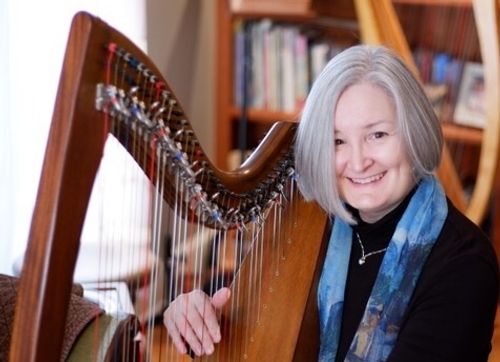
Sandy Pereira AT '27
Certified Clinical Musician and Therapeutic Harpist
Student
There are only about 1,500 Certified Therapeutic Musicians worldwide. Sandy is one of them.
As a Certified Clinical Musician and therapeutic harpist, Sandy provides live bedside music in hospitals, hospice settings, geri-psychiatric units, and skilled nursing facilities. Her work as a therapeutic musician is quiet, intentional, and deeply human. In this practice, the music is simply given.
“Therapeutic music does not require anything back from the listener. It is simply offered, creating space for calm and connection.”
For years, Sandy has brought her harp into hospital rooms and secure care units, offering therapeutic harp music to patients facing illness, recovery, and end-of-life transitions. In one secure hospital unit, aides would intentionally provide art supplies for patients to draw or paint while she played. In hospice settings, bedside sessions organically evolved into shared creative rituals.
These intersections of music and visual art affirmed what Sandy has long understood: healing is rarely confined to one modality. Integrative and expressive arts approaches often deepen emotional well-being in clinical and end-of-life care environments.
In addition to her clinical practice, Sandy mentors emerging therapeutic musicians through a therapeutic music training program accredited by the National Standards Board for Therapeutic Musicians, an affiliate of the American Music Therapy Association. She also develops educational resources for this specialized global community, including her children’s book Polo Bear and the Harp, The HOME Recordings: Strategies for Certified Therapeutic Musicians and an upcoming addition to her series . Her publications are designed to support therapeutic musicians, caregivers, and families.
A Personal Turning Point: Healing Through Art
Sandy’s decision to pursue graduate study in expressive arts therapy was shaped by personal experience.
Following a sudden melanoma diagnosis, she underwent urgent surgery and a significant recovery period. During this time, playing the harp was temporarily limited. She turned instead to watercolor and sketching.
“What began as a way to maintain fine motor skills became something deeper. It became my own holistic restoration.”
That trial clarified her desire to more intentionally integrate visual art into her therapeutic music practice. As a lifelong learner, Sandy was delighted when she discovered a graduate program that would honor interdisciplinary exploration while allowing her to continue therapeutic work and mentorship.
The Graduate Certificate In Expressive Arts Therapy offered the flexibility and academic depth she was seeking.
Why an Online Expressive Arts Therapy Program?
The asynchronous structure of MECA&D’s online graduate certificate allows Sandy to balance coursework with hospital visits, hospice care, publishing projects, and mentorship responsibilities. More importantly, the curriculum invites students to explore expressive arts therapy, emotional intelligence, and integrative healing practices through a broad, interdisciplinary lens.
“I was drawn to the openness of the program. The opportunity to integrate music and visual art into a holistic practice felt like a natural evolution.”
Sandy describes her experience in the program as “full-circle.” With prior studies in counseling and psychology, much of the foundational theory felt familiar. Yet revisiting it through decades of clinical experience has transformed her understanding.
“I first studied some of this material years ago, but now I’m examining it with a wider lens shaped by experience. That shift in perspective has been incredibly meaningful.”
Through coursework, she is reinterpreting the pillars of emotional intelligence through what she calls her “Grace and Space” framework, a lens she plans to incorporate into her upcoming book. The program’s engage-and-create structure encourages both reflection and embodiment: pausing, noticing internal shifts, and translating insight into watercolor and digital illustration.
“Art is a living thing. It’s a wonderful way to communicate your soul. You can sit down and name it to claim it.”
That renewed articulation is shaping how she integrates expressive arts therapy into her clinical and educational work.
Integrating Therapeutic Music and Expressive Arts for Emotional Well-Being
For Sandy, the most meaningful outcome of graduate study has not simply been academic growth, but articulation. The online learning environment has proven unexpectedly intimate and supportive, fostering thoughtful dialogue among peers exploring expressive arts therapy, interdisciplinary healing, and creative practice.
Looking ahead, Sandy hopes to continue expanding educational resources for Certified Therapeutic Musicians and to foster interdisciplinary collaborations that integrate music, visual art, storytelling, and other expressive modalities in service of emotional well-being.
“I hope to bring multiple expressive modalities together in service of emotional well-being, for ourselves and for those we serve.”
In hospital rooms and hospice suites, through music and imagery, Sandy continues to hold space for healing. Through her graduate studies at Maine College of Art & Design, that work is becoming more intentional and more fully integrated into her evolving practice.