Online Graduate Certificate

Maine College of Art & Design (MECA&D) offers an online Graduate Certificate in Expressive Arts Therapy designed to deepen your creative practice, expand your professional capacity, and help you support meaningful growth in the communities you serve. This 12-credit, fully online program provides structured training in expressive and creative arts techniques, allowing you to balance coursework with your life.

Schedule a Call Apply Now

TRANSFORM LIVES THROUGH ART

MECA&D’s Graduate Certificate in Expressive Arts Therapy is designed for individuals who seek to enhance their knowledge of using art to facilitate self-reflection and explore the transformative power of creativity through artmaking activities, meeting the needs of individuals from diverse backgrounds and within various contexts.

Develop Practical Expressive Arts Tools for Diverse Settings

The arts therapy graduate certificate supports professionals who want to bring creative, arts-based methods into educational, community, and wellness environments. You’ll learn how to structure expressive arts activities, respond to emotional and social needs through artmaking, and create experiences that help people process, reflect, and connect.

* If you want to continue onto a full graduate degree after completing your graduate certificate, you can transfer credits into the online Master of Arts in Education program.

Program Highlights

FLEXIBLE ONLINE FORMAT

Our art therapy program is intentionally designed for working professionals. Courses are offered fully online and asynchronously, so you can complete readings, creative assignments, and reflections on a schedule that fits around your work and personal responsibilities.

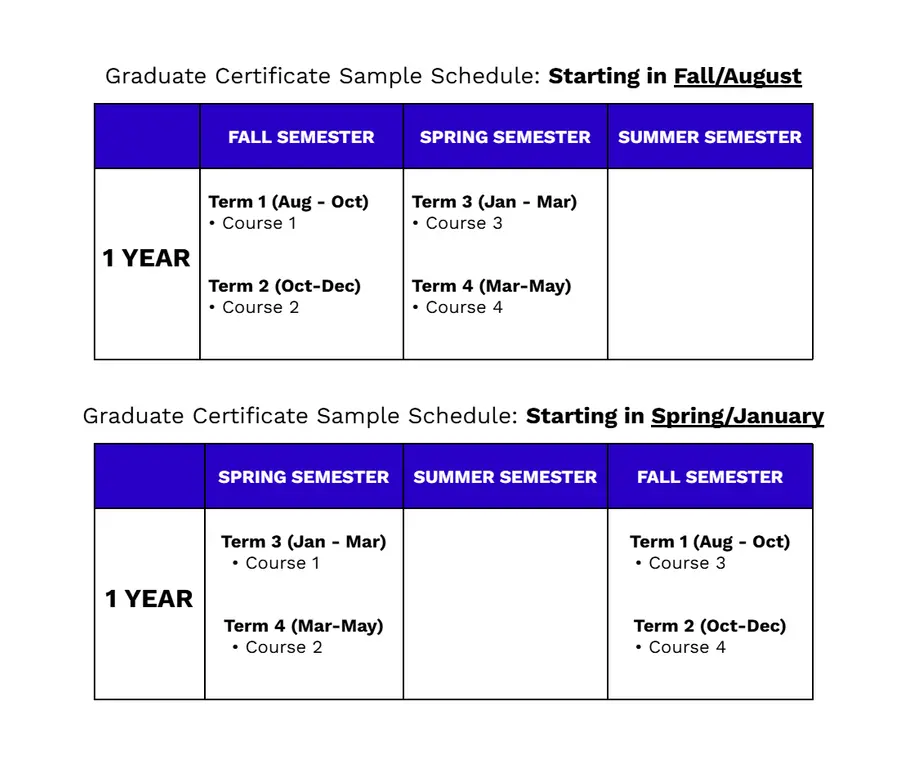
Classes run in intensive eight-week e-terms throughout the year, and the four required courses can be completed in approximately nine months. You can choose to move through the program at that pace or distribute your coursework over additional e-terms if you prefer a lighter load. Small class sizes help you stay connected to faculty and peers, even in an online environment.

CORE LEARNING OUTCOMES

As a student in the Graduate Certificate in Expressive Arts Therapy, you’ll build a foundation in expressive arts theory and practice that you can apply across educational and human services contexts.

By the end of the program, you will be able to:

  • Understand the foundational theories and principles of expressive arts therapy and how they can be applied in educational and therapeutic settings
  • Implement expressive arts strategies that promote holistic development in students and clients, addressing emotional, cognitive, and social growth
  • Develop and use creative techniques and interventions that foster emotional intelligence and empathy in diverse populations
  • Design adaptive art activities and environments that meet learners and clients where they are, supporting accessibility and inclusion
  • Explore and pursue new professional opportunities in art education, classroom teaching, human services, and fine arts by integrating your expressive arts training into your existing or future roles

These outcomes guide the sequence of courses, ensuring that what you learn can be applied immediately in your current workplace or community setting.

COMMUNITY & PROFESSIONAL ENGAGEMENT

Community and professional context are central to how you’ll learn in this certificate. You study alongside a cohort of educators, artists, human services professionals, and community practitioners who each bring real-world experience to the online classroom. Discussions, reflections, and projects encourage you to connect course concepts directly to the people and communities you serve.

Assignments often invite you to:

  • Adapt expressive arts techniques to your current workplace or client population
  • Design activities that respond to the needs, strengths, and goals of specific individuals or groups
  • Reflect on your role as a facilitator, educator, or artist working in support of others’ well-being

The College’s broader commitment to community engagement and inclusive arts education provides a strong backdrop for this work, whether you are based in Maine or participating from another region.

LEARN FROM EXPERT FACULTY

Courses in the Graduate Certificate in Expressive Arts Therapy are taught by faculty and practitioners who bring experience across artmaking, education, human services, and expressive arts practice. They integrate theoretical reading with hands-on creative work, case examples, and guided reflection so you can see how expressive arts approaches function in real-world settings.

You’ll benefit from:

  • Instructors who understand both the creative process and the realities of working with students, clients, and communities
  • Structured feedback on your projects, reflections, and facilitation plans
  • Opportunities to discuss ethical, practical, and logistical considerations of using expressive arts in non-clinical settings

This blend of academic grounding and applied experience supports you as you develop your own approach to expressive arts work.

Why Earn a Graduate Certificate in Expressive Arts Therapy?

A Graduate Certificate in Expressive Arts Therapy gives you focused training in using art and the creative process to support emotional insight, communication, and growth. It strengthens your ability to design and facilitate art-based experiences that complement work in education, human services, community programs, and related fields.

With this certificate, you can:

  • Enhance your existing role with expressive arts tools that deepen engagement and support well-being
  • Broaden your professional skillset in areas such as group facilitation, emotional support, and reflective practice
  • Explore holistic, creative approaches to mental health and wellness in non-clinical contexts
  • Prepare for further graduate study in education or related fields, including the online Master of Arts in Education

Why Earn a Graduate Certificate Online at MECA&D?

Established in 1882, Maine College of Art & Design has a long history of attracting top faculty and students. Courses are taught by MECA&D faculty, as well as experts in the field. The program is made up of a diverse cohort of artists with experience in the classroom, in the museum, at human services agencies, and in the community. The Graduate Certificate in Expressive Arts Therapy online program provides our students with the highest caliber of education while allowing them to balance professional and family commitments.

  • Intentionally flexible programs designed to support education while maintaining a job and balancing family and everyday life.
  • Small class sizes make it easy to connect with professors and fellow students.
  • Opportunity to study exclusively online.
  • Online courses are offered asynchronously, allowing completion of readings and assignments at your own pace.

Curriculum & Courses

The art therapy graduate certificate is a 12-credit online program made up of four required courses. Together, these courses provide an integrated introduction to expressive arts theory, emotional and social-emotional learning, resilient and inclusive environments, and adaptive art practices.

Program Description

The Graduate Certificate in Expressive Arts Therapy introduces you to a holistic, multi-modal approach to using art and creative process in educational and human-services settings. Through guided online study and hands-on creative work, you’ll explore the core theories of expressive arts therapy and learn how these principles translate into meaningful, non-clinical practice.

Throughout the program, you’ll experiment with creative techniques that support emotional expression, self-reflection, and social-emotional growth. You’ll also learn how to design adaptive art experiences that meet the needs of diverse learners and communities, helping you integrate expressive arts methods into your current or future professional roles.

Please note: this certificate does not lead to professional art therapy licensure. Individuals seeking to become certified art therapists must complete graduate-level training and supervised clinical hours as outlined by the Art Therapy Credentials Board (ATCB).

Program Requirements

The Graduate Certificate in Expressive Arts Therapy requires a minimum of 12 credits.

Required Courses

3
3
3
3
Program Outcomes
  • Understand the foundational theories and principles of expressive arts therapy and their applications in various educational and therapeutic contexts
  • Implement strategies that promote holistic development in students and clients, addressing emotional, cognitive, and social growth through expressive arts practices
  • Develop and utilize creative techniques and interventions that foster emotional intelligence and empathy in diverse populations, supporting individuals in understanding and managing their emotions effectively
  • Develop and employ a comprehensive toolkit of expressive and adaptive art techniques and activities designed to meet learners and clients where they are, facilitating personalized and impactful therapeutic or educational experiences
  • Explore and pursue new professional opportunities in the fields of art education, classroom teaching, human services, and fine arts, leveraging the specialized training provided by the certificate program
Core Courses

Emotional Intelligence & Artistic Learning (3 credits)

Examine the relationship between creative practice and emotional development. You’ll explore how artmaking can help individuals recognize, express, and regulate emotions, and you’ll design activities that cultivate empathy, self-awareness, and interpersonal skills in educational or community settings.

Resilient Learning Environments (3 credits)

Focus on creating learning and engagement spaces that are trauma-informed, supportive, and responsive to the needs of diverse participants. This course emphasizes strategies for building trust, fostering safety, and using expressive arts approaches to help learners and clients develop resilience.

Theoretical Foundations and Methods of Expressive Arts Therapies (3 credits)

Gain an introduction to key theories underlying expressive arts therapy and related practices. You’ll consider how multi-modal artmaking, such as visual art, movement, sound, and narrative, can be used to support reflection, insight, and growth, particularly in non-clinical educational and community contexts.

Adaptive Art: Fostering Inclusive Creative Practices (3 credits)

Learn how to design and adapt creative experiences for individuals with different abilities, backgrounds, and needs. Drawing on principles of accessibility and inclusive pedagogy, you’ll explore materials, formats, and facilitation strategies that support neurodivergent participants and people with varied physical, cognitive, and sensory profiles.

Admission Requirements & How to Apply

Application Requirements

Application fee: $70

Campus: Online

*NO GRE required

PERSONAL STATEMENT

Please submit a personal statement of no more than 750 words that describes your academic background, professional experiences, and personal motivations that have led you to pursue this graduate program, and how you envision the program helping you achieve your long-term career goals.

REFERENCES: TWO REQUIRED

As part of your application, we require two professional recommenders to complete an Endorsement Form. We recommend choosing individuals familiar with your academic or professional experience and who can speak to your strengths, achievements, and potential for success in graduate school. Recommendations submitted by relatives or friends will not be accepted. Once you have identified your recommenders, you will need to provide their contact information in your application portal. Each recommender will then receive an email with a link to complete the Endorsement Form.

RÉSUMÉ

A current Résumé or Curriculum Vitae is required with your submitted application.

TRANSCRIPTS

Applicants should have a 3.0 grade point average (GPA) or above from all previous degrees held. You can either submit unofficial transcripts in the application portal as a PDF attachment or request official college transcripts to be sent electronically to graduateadmissions@meca.edu or to the following address: Maine College of Art & Design, Attn: Graduate Admissions, 522 Congress Street, Portland, Maine 04101. If admitted, you must request that an official transcript be sent directly to our office from the Registrar's Office of each college/university attended. We accept transcripts both electronically and in hard copy:

  • Electronic Transcripts: Please have your institution send the transcript directly to graduateadmissions@meca.edu. Please note that we can only accept copies sent directly from the institution.
  • Paper Transcripts: Please send hard copies of transcripts to: Maine College of Art & Design, Attn: Graduate Admissions, 522 Congress Street, Portland, Maine 04101.
  • You may request transcripts be sent to us directly from the institution, or you may send them yourself as long as they remain sealed in the original university envelope.

INTERNATIONAL APPLICANTS

Prospective international students are required to submit TOEFL, IELTS, or equivalent examination scores. English Language Exams may be waived if English is your first language. We welcome international applicants, but please note that this is an online program. Any program that is conducted primarily online is not eligible for a student visa for study, but students may enroll at a distance or study under a different eligible visa type.

PROOF OF ENGLISH LANGUAGE PROFICIENCY

Non-native English-speaking international applicants must submit proof of English language proficiency. Demonstration of a sufficient level of proficiency is a prerequisite for admission. The following are acceptable forms of documentation and their minimum test scores, if applicable:

  • Written TOEFL Test: 550
  • Internet TOEFL Test: 79
  • Pearson PTE Test: 53
  • International English Language Testing System (IELTS): 6.5
  • Duolingo English Test: 100
  • Graduation from a US high school with at least two (2) years of high school English, not in conjunction with English as a Second Language (ESL), and documentation of a B average or higher.
  • Completion of two (2) consecutive semesters of English Composition taken at a regionally accredited US college while carrying a full-time course load and not in conjunction with ESL. A minimum grade of B is required in each semester.
  • Completion of the equivalent of two (2) years at an English-speaking higher education institution and a minimum 3.0 GPA. A school official should provide a written statement that English is the primary language of instruction as documentation.

QUESTIONS

For program-specific application questions, please contact online@meca.edu.

Key Dates And Deadlines

Fall 2025: July 15, 2025

Spring 2026: December 1, 2025 EXTENDED to December 15, 2025

Special: Applications are accepted on a rolling basis with priority consideration for applicants who submit applications and supplemental materials by deadlines.

How to Apply - Quick Steps

  • Select the Graduate Certificate in Expressive Arts Therapy as your intended program.

Write your personal statement.

  • In up to 750 words, describe your academic background, professional experiences, motivations for pursuing the certificate, and how you hope to use expressive arts in your work.

Add your recommenders.

  • Provide contact information for two professional references. Each will receive an email with a link to complete an Endorsement Form.

Upload your résumé or CV.

  • Highlight your education, professional roles, creative practice, and any relevant work with communities or clients.

Submit your transcripts.

  • Upload unofficial transcripts in the application portal or request that official transcripts be sent directly to Maine College of Art & Design. A 3.0 GPA or higher from previous degrees is expected.

Pay the application fee.

  • Submit the $70 application fee to complete your application.

Provide proof of English proficiency (if required).

  • International applicants whose first language is not English should submit approved test scores or documentation as outlined in the admission requirements.

Connect with the admissions team.

  • Reach out to online@meca.edu with questions or to discuss your timeline and goals.

Schedule a Call Apply Now

Career Outcomes & Professional Pathways

The Graduate Certificate in Expressive Arts Therapy prepares you to integrate expressive, arts-based approaches into roles you may already hold, or aspire to, in education, human services, and the arts. You’ll leave with a toolkit of practices that can enhance your work, making it more engaging, reflective, and supportive of holistic development.

CAREER PATHS & JOB TITLES

Depending on your background and primary field, this certificate can support roles such as:

  • Educator incorporating expressive arts and SEL into the classroom
  • Teaching artist or workshop facilitator focused on creative wellbeing
  • Community arts educator or program coordinator
  • Human services professional using arts-based activities in supportive programming
  • Recreation or youth program leader integrating creative expression into activities
  • Artist seeking to bring expressive arts methods into community or educational projects

This certificate is not a clinical art therapy credential and does not, on its own, prepare you for licensed art therapist roles.


WHERE GRADUATES WORK

Graduates apply what they learn in a range of settings, including:

  • PreK–12 schools and after-school or enrichment programs
  • Community and youth arts organizations
  • Human services and nonprofit agencies
  • Wellness, recreational, and community centers (in non-clinical roles)
  • Museums and cultural institutions offering educational or public programs

Your specific pathway will depend on your prior education, experience, and the context in which you choose to apply expressive arts techniques.


GRADUATE SUCCESS & PARTNERSHIPS

Graduates of the Graduate Certificate in Expressive Arts Therapy bring expressive and creative arts strategies into their work to:

  • Design and lead art-based workshops and group experiences
  • Support emotional learning and reflection within educational or community programs
  • Strengthen existing curricula, programs, or services with creative, participant-centered approaches

The certificate builds on Maine College of Art & Design’s broader history of arts-based community engagement, helping you situate your practice within a larger tradition of creative, socially responsive work.

WHAT YOU’LL GAIN

By completing the expressive arts therapy certificate, you will gain:

  • A 12-credit graduate-level credential focused on expressive arts
  • A working knowledge of expressive arts theory and its applications in non-clinical contexts
  • Practical, adaptable art-based techniques for supporting emotional, cognitive, and social development
  • Strategies for creating inclusive, accessible, and responsive creative environments
  • Expanded professional options in art education, classroom teaching, human services, and community arts
  • Greater confidence using the creative process to support reflection, well-being, and connection

Accreditation & Institutional Credibility

ACCREDITATION & ACADEMIC STANDARDS

Maine College of Art & Design is accredited by the New England Commission of Higher Education (NECHE). The College’s accreditation status was renewed in 2016.

The New England Commission of Higher Education (NECHE) is the regional accreditation agency for colleges and universities in New England, as well as international schools. NECHE accreditation attests to a school's high quality and integrity.

Accreditation, which is voluntary, indicates that an institution has met an external set of criteria for the programs it offers and adheres to threshold standards as a foundation for academic strength and operational integrity. It can be helpful in the transfer of credits from one institution to another.

Inquiries regarding the College’s accreditation should be directed to Melissa Sullivan, Executive Assistant to the President, telephone 207.699.5043 / email msullivan@meca.edu.

Contact

New England Commission of Higher Education (NECHE)
3 Burlington Woods Drive, Suite 100
Burlington, MA
01803-4514
781.425.7785
info@neche.org

As part of the College’s online graduate offerings, the Graduate Certificate in Expressive Arts Therapy follows established academic policies, including minimum GPA expectations, clear credit requirements, and standards for satisfactory academic progress, to ensure that your certificate reflects rigorous graduate-level study.


PROFESSIONAL MEMBERSHIPS & ASSOCIATIONS

Maine College of Art & Design is a member of the Association of Independent Colleges of Art and Design (AICAD), a consortium of leading art and design schools. This membership connects students and alumni to a broader community of creative institutions and practitioners.

RECOGNITION & INSTITUTIONAL REPUTATION

Founded in 1882, Maine College of Art & Design is the oldest art school in Maine and a recognized leader in art and design education. Located in Portland’s Arts District, our art therapy school is known for its intimate scale, strong faculty mentorship, and commitment to creative community engagement.

The Graduate Certificate in Expressive Arts Therapy extends this tradition into an online format, bringing the College’s emphasis on creative inquiry and meaningful impact to working professionals wherever they are.


COMMITMENT TO QUALITY & CONTINUOUS IMPROVEMENT

The Graduate Certificate in Expressive Arts Therapy is part of Maine College of Art & Design’s evolving portfolio of online graduate programs. The College regularly reviews curriculum, academic policies, and student feedback to keep courses relevant, rigorous, and responsive to the needs of educators, artists, and human services professionals. Clear expectations, engaged faculty, and ongoing evaluation support a high-quality learning experience from your first e-term through completion of the certificate.

Explore Details

Cost and Financial Aid

Tuition and fees:

Cost Per Credit: $720

Technology Fee: $100 per e-term

Click HERE for additional information.

Financial Aid Office: Click HERE or email finaid@meca.edu.

*This program is eligible for Federal Financial Aid

Sample Program Schedule
an image

Frequently Asked Questions

1. What is expressive arts therapy?

Expressive arts therapy is a multi-modal, arts-based approach that uses creative processes, such as drawing, movement, storytelling, music, and imaginative play, to support emotional reflection, communication, and personal growth. In non-clinical settings, expressive arts methods help individuals explore feelings, build resilience, and engage in meaningful self-expression.

2. Can I work while completing the certificate?

Yes. The program is built for working adults. The asynchronous online format allows you to complete coursework when it fits your schedule, making it possible to balance full-time or part-time employment, caregiving, or other responsibilities while earning your certificate.

3. Can I transfer in any courses I have taken outside of Maine College of Art & Design and use those credits towards the graduate certificate?

The program allows for flexibility in regard to course offerings. Students can request to transfer in a maximum of one graduate-level course (3 credits) taken outside of Maine College of Art & Design from an accredited college or university (to use towards a Graduate Certificate), with the program director’s approval. Students must have earned at least a “B” in the course. This course cannot be used to fulfill the requirements for another degree.

4. Are required courses offered every semester?

Yes, typically, one required course is offered each e-term. This program has a course offered in four of the five e-terms. E-terms are different from the traditional Maine College of Art & Design academic calendar. The e-term schedule includes intensive eight-week courses. There are two e-terms in the Fall, two in the Spring, and one in the Summer. Each course is typically three credits and is an accelerated version of a typical 15-16 week semester course. In other words, the same amount of material is covered, but in a shorter time span.

5. Do I need to register for two courses each semester, or can I register for one (choose one e-term each semester)?

Students are not required to register for each e-term, and many choose to register for one course each Fall and Spring semester. This means you can register for e-term 1 OR 2 in the Fall and e-term 3 OR 4 in the Spring. However, this will lengthen the time to program completion.

Link to the Online Academic Calendar: HERE
an image

Request Information

Loading...

Events

News

Spotlights