Music Therapy as a Career: Integrating Sound into Expressive Arts Practice
Key Insights
- Music therapy blends creative expression with structured facilitation to support emotional awareness, communication, and well-being.
- You don't need to become a licensed therapist to apply music-based techniques in education, community programs, or wellness settings.
- Demand for arts-integrated learning and social-emotional support continues to grow across schools, nonprofits, and community organizations.
- The Graduate Certificate in Expressive Arts Therapy at Maine College of Art & Design equips professionals with practical, non-clinical tools to integrate music and other art forms into their work.
Music moves people physically, emotionally, and cognitively. In professional settings, that impact becomes a powerful tool. Music therapy, when approached through expressive arts practice, shifts the focus from performance to process. The goal is not perfection. Rather, it's connection.
Within the broader field of expressive arts, music acts as both a standalone modality and a bridge to other forms of creative engagement. Rhythm can ground attention. Melody can unlock memory. Sound can help individuals express what words cannot.
For professionals in education, community programming, or human services, integrating music into expressive arts practice offers a structured yet flexible way to foster engagement and reflection.
Understanding Music Therapy as a Career Path
Music therapy as a licensed profession requires specialized clinical training and certification. But there's a broader, highly valuable career pathway focused on non-clinical, arts-based facilitation.
This is where expressive arts therapy comes into play.
Through programs like the Graduate Certificate in Expressive Arts Therapy, professionals learn how to apply music intentionally in settings such as:
- Classrooms and enrichment programs
- Community arts organizations
- Youth and recreation programs
- Wellness and cultural centers
Rather than diagnosing or treating clinical conditions, practitioners design experiences that support emotional awareness, communication, and participation.
A report from the National Endowment for the Arts highlights that arts participation is linked to improved social and emotional outcomes, reinforcing the value of integrating music into community-based work.
How Music Fits into Expressive Arts Therapy
Music within expressive arts therapy is not confined to instruments or formal training. Instead, it's about accessible, inclusive engagement.
Professionals might use music to:
- Facilitate group rhythm exercises that build connection
- Encourage storytelling through sound and improvisation
- Support emotional regulation through listening and reflection
- Combine music with movement, visual art, or writing for multi-modal experiences
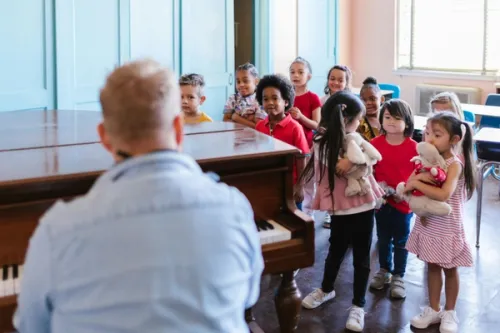
In practice, this could look like a teacher incorporating rhythm-based activities to improve classroom focus, or a community program leader using music circles to foster social interaction.
The emphasis remains consistent: process over product, participation over performance.
Building Skills Through the Graduate Certificate In Expressive Arts Therapy
For those ready to formalize their approach, Maine College of Art & Design offers a streamlined pathway to build expertise.
The Graduate Certificate in Expressive Arts Therapy is a 12-credit, fully online program designed for working professionals. Students can complete the certificate in as little as five months through accelerated eight-week terms.
Required coursework explores:
- Expressive arts theory and foundational methods
- Facilitation strategies for diverse populations
- Ethical and inclusive approaches to creative engagement
- Practical applications of music and other art forms
Elective options such as Harmonic Pathways: Music and Well-Being allow students to dive deeper into how sound and music influence emotional and cognitive experiences.
Graduates leave with the ability to:
- Design and lead arts-based experiences
- Adapt creative activities for different abilities and settings
- Integrate expressive arts into existing professional roles
- Support reflection, communication, and engagement through creative practice
Who Should Consider This Path?
This career direction is ideal if you want to expand your impact without necessarily pursuing clinical licensure.
You'll find strong alignment if you are:
- An educator seeking new tools for student engagement
- An artist interested in community-based work
- A human services professional exploring creative approaches
- A program coordinator or facilitator working in wellness or youth development
Because the program is designed for non-clinical application, it opens doors across industries while remaining grounded in ethical, intentional practice.
Career Opportunities with Music and Expressive Arts
Professionals trained in expressive arts, especially those incorporating music, can pursue roles such as:
- Teaching artist or workshop facilitator
- Community arts educator
- Youth program leader
- Recreation specialist
- Arts-based program coordinator
Work environments often include schools, nonprofits, cultural institutions, and community centers. As organizations place greater emphasis on social-emotional learning and community well-being, these roles continue to gain relevance.
Bring Sound Into Your Work
Music therapy as a career is broader than most people assume, and expressive arts practice is broader still. For educators and community facilitators working at the intersection of creative work and human connection, sound isn't a specialty to be siloed off. It's one of the modalities through which people engage, reflect, and grow.
Developing the skills and theoretical grounding to use it well is the work. And that work begins with intentional training.
Request information today to learn more about the Graduate Certificate in Expressive Arts Therapy at Maine College of Art & Design.
Please note: The Graduate Certificate in Expressive Arts Therapy at Maine College of Art & Design does not lead to professional licensure or certification as an art therapist or music therapist. Individuals seeking licensure must complete graduate-level clinical training and supervised hours as required by the relevant credentialing body (ATCB).