How Does Expressive Art Therapy Support Memory Care?
Key Insights
- Expressive arts therapy is consistently associated with improved quality of life, mood, engagement, and communication for people living with dementia.
- Creative approaches such as visual art, movement, and storytelling support emotional expression and reduce distress without relying on memory recall or verbal precision.
- In-the-moment creative experiences reinforce personhood in memory care by prioritizing presence, agency, and relationship over performance or accuracy.
Dementia is often defined by what changes. Language becomes less reliable. Short-term memory fades. Familiar routines can feel harder to navigate. Yet one capacity often remains accessible far longer than many cognitive skills: the ability to create, respond, and connect through expressive experience.
Expressive arts therapy builds on this reality. Using creative processes as the primary mode of engagement, it offers people living with dementia meaningful ways to communicate, participate, and stay connected to others, without relying on memory or verbal fluency. Over time, research has increasingly shown that these approaches can play a valuable role in non-pharmacological memory care.
What Expressive Arts Therapy Looks Like in Memory Care
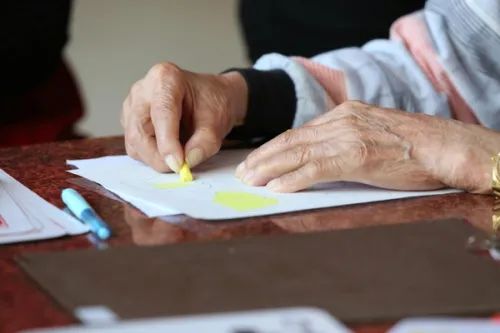
Expressive arts therapy uses creative activity as a therapeutic pathway rather than solely a recreational outlet. The emphasis is on process, relationship, and emotional expression, not on artistic skill or finished products.
In memory care settings, expressive arts therapy commonly includes:
- Visual art-making, such as drawing, painting, collage, or sculpture
- Art appreciation, including guided discussion of images, objects, or museum-based programs
- Expressive movement and dance, adapted to physical ability
- Creative storytelling, which replaces memory demands with imagination and shared meaning
Across these formats, research suggests outcomes are strongest when sessions emphasize supportive facilitation and person-centered engagement. A comprehensive systematic review of creative art therapy interventions published between 2015 and 2020 identified positive effects across these approaches, particularly when activities were adapted to individual needs.[1]
Programs are typically adjusted as dementia progresses. Structured formats are often used when attention, mobility, or cognitive flexibility are limited, while open-ended approaches support choice and autonomy earlier in the disease process. This adaptability makes expressive arts therapy especially well-suited to memory care.
Why Non-Pharmacological Approaches Matter in Dementia Care
Behavioral and psychological symptoms of dementia, including agitation, apathy, anxiety, depression, and emotional distress, shape daily life in memory care settings. These symptoms strongly influence functioning, caregiver burden, and overall quality of life. [2]
Because of this, clinical guidance increasingly recommends non-pharmacological approaches as a first-line response when safety allows. Creative and psychosocial interventions are identified as effective strategies for improving mood and reducing distress in people living with dementia.[3]
Expressive arts therapy fits within this framework by addressing emotional, relational, and identity-based needs directly, without relying on medication or complex verbal processing.
How Expressive Arts Therapy Supports Memory Care Outcomes
Preserving personhood and identity
Person-centered dementia care is grounded in the concept of personhood, defined as the recognition and respect afforded to an individual within relationships and social context.
Expressive arts therapy supports personhood by allowing individuals to make choices, express preferences, and participate as creative contributors. Across studies, these experiences are linked to improved self-esteem and sustained identity expression during sessions, even as cognitive abilities change.[1]
Improving mood and emotional well-being
Mood-related outcomes are among the most consistently reported benefits of expressive arts therapy in dementia care. During and after creative sessions, participants often demonstrate increased pleasure, reduced depressive symptoms, and improved observed well-being.[1]
Museum-based programs that combine guided art viewing and art-making have also shown measurable improvements in self-rated quality of life, along with reductions in anxiety.[4]
Reducing agitation and behavioral distress
Agitation and apathy are challenging symptoms in memory care environments. These behaviors can disrupt daily routines and strain caregiver–resident relationships.
Studies using validated measures such as the Cohen–Mansfield Agitation Inventory frequently report reductions in agitation and aggressive behaviors during expressive arts therapy interventions. These findings align with broader dementia care guidance that prioritizes individualized, non-drug approaches when appropriate.[1, 3]
Supporting communication beyond words
As verbal language becomes more fragmented, expressive arts therapy provides alternative pathways for communication. Visual imagery, gesture, movement, and shared attention allow emotional meaning to surface without relying on structured speech.
Creative storytelling research shows that people living with dementia retain the ability to create humor, express emotion, and assume valued social roles even when language is disorganized. By emphasizing imagination rather than memory, these approaches reduce frustration and support relational connection.[5]
Encouraging attention, engagement, and embodied expression
Although expressive arts therapy is not positioned as a cognitive treatment, many studies measure attention, engagement, and participation. Participants often show increased sustained attention and reduced disengagement during creative sessions compared with non-creative activities.[1]
Movement-based expressive therapies, including dance therapy, further support engagement by integrating rhythm, body awareness, and social connection, particularly when verbal communication is limited.[6]
Frequently Asked Questions
Is expressive arts therapy appropriate for advanced dementia?
Yes. Expressive arts therapy can support engagement even in advanced stages of dementia when activities are structured and sensory-based. These approaches emphasize guided prompts, simplified materials, and shared presence rather than independent task completion or verbal accuracy. This makes participation possible even as cognitive and language abilities change.
Does someone need prior art experience to benefit?
No. Expressive arts therapy prioritizes the creative process rather than artistic skill or technical ability. Activities are adapted to individual strengths and comfort levels, allowing participation across a wide range of cognitive and physical abilities. Many people engage meaningfully without any previous art experience.
How is expressive arts therapy different from recreational activities?
Expressive arts therapy is guided by therapeutic intent and grounded in person-centered care principles. Sessions are facilitated to support communication, emotional expression, and relational engagement rather than entertainment or task completion. The focus remains on presence, agency, and connection rather than outcomes or performance.
Advance Your Practice Through Expressive Arts Training
As memory care increasingly prioritizes person-centered, non-pharmacological approaches, there is a growing need for professionals who understand how creative processes support emotional expression, communication, and dignity.
Maine College of Art & Design’s online Graduate Certificate in Expressive Arts Therapy is designed for educators, artists, and human services professionals who want to integrate expressive, arts-based methods into community and educational settings.
This 12-credit, fully online program, completed in 9–10 months, provides structured training in expressive arts theory and practice while allowing you to balance coursework with your life. The curriculum emphasizes ethical facilitation, adaptability, and real-world application in non-clinical contexts, including work with aging and memory care populations.
Explore program details today to see how you can integrate expressive arts therapy into your practice.
Please note that this certificate is not a clinical art therapy credential and does not, on its own, qualify graduates for licensure as an art therapist.
Sources
- Emblad SYM, Mukaetova-Ladinska EB. Creative Art Therapy as a Non-Pharmacological Intervention for Dementia: A Systematic Review. Journal of Alzheimer’s Disease Reports. 2021;5(1):353-364. doi:10.3233/ADR-201002
- Cloak, N., Schoo, A., & Al Khalili, Y. (2024). Behavioral and psychological symptoms of dementia. StatPearls. https://www.ncbi.nlm.nih.gov/books/NBK551552/
- Scales, K., Zimmerman, S., & Miller, S. J. (2018). Evidence-based nonpharmacological practices to address behavioral and psychological symptoms of dementia. The Gerontologist, 58(Suppl 1), S88–S102. https://doi.org/10.1093/geront/gnx167
- Schall A, Tesky VA, Adams A-K, Pantel J. Art museum-based intervention to promote emotional well-being and improve quality of life in people with dementia: The ARTEMIS project. Dementia. 2017;17(6):728-743. doi:10.1177/1471301217730451
- Basting, A. D. (2006). Creative Storytelling and Self-Expression among People with Dementia. In A. LEIBING & L. COHEN (Eds.), Thinking About Dementia: Culture, Loss, and the Anthropology of Senility (pp. 180–194). Rutgers University Press. https://doi.org/10.2307/j.ctt5hjbhp.12
- Helm, J. B., & Gill, K. L. (1974). An Essential Resource for the Aging: Dance Therapy. Dance Research Journal, 7(1), 1–7. https://doi.org/10.2307/1478650