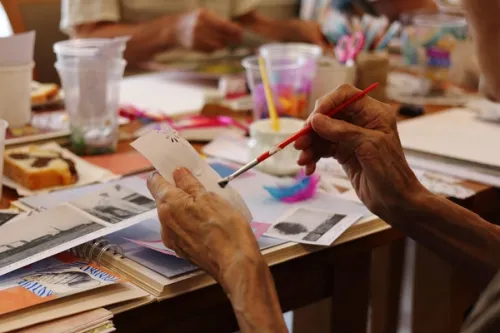
How Expressive Arts Therapy Supports Emotional Wellness in Seniors
Key Insights
- Emotional wellness challenges often increase in later adulthood due to loss, transition, and isolation.
- Expressive arts therapy offers structured, nonverbal ways to support reflection and emotional processing.
- Research links arts engagement in seniors to improved mood, reduced loneliness, and social connection.
- Specialized training helps professionals apply expressive arts ethically in non-clinical settings.
As people age, emotional wellness can become harder to maintain, particularly during periods of transition, loss, or reduced independence.
Traditional talk-based approaches may not always meet the needs of older adults, especially when emotion is difficult to articulate. Expressive arts therapy provides alternative pathways for reflection and connection through creative practice.
By emphasizing process rather than performance, expressive arts approaches support emotional wellness in ways that feel accessible, dignified, and responsive to lived experience.
Why Emotional Wellness Is a Growing Concern for Seniors
Later adulthood often includes overlapping emotional stressors. Retirement can shift identity and daily structure, health changes may limit independence, and the loss of loved ones can compound feelings of isolation. According to the World Health Organization, mental disorders like depression affect approximately 14% of adults aged 70 and older.
The National Institute on Aging notes that emotional well-being in older adults is closely tied to social connection, purpose, and meaningful activity. When opportunities for engagement decline, emotional distress and loneliness become more likely.
Creative engagement helps address these challenges by supporting emotional expression, social interaction, and a sense of agency. These elements are foundational to emotional wellness at any age, but they are especially important in later life.
What Expressive Arts Therapy Is and How It Works
Expressive arts therapy is an integrative practice that uses creative processes such as visual art, movement, music, and writing to support emotional reflection and self-awareness. The emphasis is on experience rather than artistic skill, which makes the approach accessible to individuals with diverse abilities and backgrounds.
Instead of asking participants to explain how they feel, expressive arts therapy invites exploration through creative action. Color, movement, rhythm, and narrative become tools for meaning-making, allowing emotion to surface organically and at an individual pace.
Why Creative Expression Matters in Later Life
Creative expression supports emotional processing in ways that do not rely solely on verbal communication. For seniors, this can be especially meaningful when language feels limiting or emotionally taxing.
Through expressive arts activities, older adults can:
- Engage memory and identity through sensory experience
- Explore complex emotions without pressure to explain or analyze
- Experience moments of presence, curiosity, and connection
Together, these experiences support emotional awareness while honoring personal history and lived experience.
Research on Expressive Arts and Emotional Health in Aging Populations
A growing body of research supports the emotional benefits of arts engagement in later life. A longitudinal study published by the Gerontological Society of America found that older adults who participated in structured arts programs experienced improved mood, reduced loneliness, and increased social engagement over time.
Additional research published in Frontiers in Psychology links creative expression in older adults to emotional resilience and cognitive flexibility, further supporting the role of expressive arts in healthy aging.
How Expressive Arts Therapy Is Used With Seniors Today
Expressive arts therapy is widely applied in non-clinical environments that serve older adults. These settings include senior centers, community arts organizations, residential communities, and educational programs focused on lifelong learning.
Programs are intentionally structured to remain flexible and responsive. Facilitators adapt activities based on participant needs, taking into account physical ability, sensory preferences, and cognitive changes. This adaptability allows expressive arts therapy to support emotional wellness without overstimulation or rigid expectations.
Core Skills Needed to Facilitate Expressive Arts With Older Adults
Facilitating expressive arts therapy with seniors requires a distinct set of professional skills. Practitioners must be attentive to emotional cues, responsive to individual needs, and grounded in ethical practice.
Effective facilitation often involves:
- Creating environments that feel emotionally safe and inclusive
- Observing and responding to nonverbal communication
- Adapting creative activities in real time to support accessibility
These competencies are especially relevant for educators, artists, and human services professionals working in aging-focused settings.
Frequently Asked Questions About Expressive Arts Therapy for Seniors
Can expressive arts therapy be adapted for seniors with physical or cognitive limitations?
Yes. Activities are routinely modified to accommodate mobility, sensory changes, and cognitive differences. Facilitators adjust pacing, materials, and structure to support participation without frustration or fatigue.
Is expressive arts therapy appropriate for group settings with older adults?
Yes. Group-based expressive arts activities can foster connection, shared reflection, and community. Facilitators structure sessions to encourage participation while respecting individual comfort levels.
How is progress typically observed in expressive arts therapy programs for seniors?
Progress is usually observed through increased participation, expression, and engagement over time. Outcomes are qualitative and vary from individual to individual. Reflection and observation are primary tools for assessing impact.
Online Graduate Certificate in Expressive Arts Therapy
For those working with older adults, the ability to hold space for reflection, expression, and connection matters.
Maine College of Art & Design’s Graduate Certificate in Expressive Arts Therapy supports educators, artists, and human services professionals who want to bring creative, arts-based approaches into aging-focused environments. The fully online, 12-credit program can be completed in approximately 9 to 10 months and focuses on expressive arts theory, facilitation, and ethical practice. Graduates leave with practical tools that support emotional wellness while honoring lived experience.
Explore the program to learn how expressive arts training can support the communities you serve.