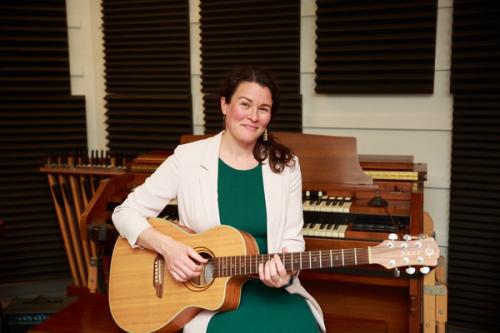
Kate Beever, MA, MT-BC
Music Therapist and Educator Focused on Healing Through Music
Instructor
Music has always been central to Kate Beever’s life. Growing up in a creative, musical family, she learned early that music isn’t about perfection—it’s about expression, curiosity, and human connection.
That perspective shaped her path as both a drummer and educator. While teaching, one pivotal moment with a student helped define her career in music therapy.
“He could only use one side of his body,” she recalls. “But he was so motivated to play drums that he started using both sides. And I thought, this is what I want to do.”
This experience led Kate to pursue a career as a board-certified music therapist (MT-BC), where she now helps individuals reconnect with themselves through rhythm, sound, and creative expression.
Music Therapy in Healthcare: Supporting Emotional, Cognitive, and Physical Well-Being
Today, Kate works across hospitals, healthcare systems, and community settings, providing music therapy services to individuals facing complex physical, emotional, and cognitive challenges.
In these environments, music becomes more than a creative outlet, it becomes a powerful therapeutic tool.
“I think it’s the parts of the self people had and pushed aside, and then when they most need it, it comes out.”
In one session, a patient shared a meaningful song while navigating serious medical challenges. As the music played, emotions surfaced, not only for the patient, but for the entire care team.
“It broke the ice,” Kate explains. “It opened a conversation that hadn’t been possible before.”
Moments like these demonstrate how music therapy can act as a “third party in the room,” fostering communication, emotional release, and human connection in healthcare settings.
Expanding Access to Music
After completing her graduate studies in New York, Kate returned to Maine and found limited opportunities in the field of music therapy. Rather than waiting for a position, she created one.
As the founder of Maine Music & Health, Kate has expanded access to music therapy programs across healthcare organizations and community-based settings. Her work has helped increase awareness of the benefits of music therapy and its growing role in integrative care.
“It’s been incredible to see how much the field has expanded,” she reflects.
You Don’t Have to Be a Musician to Benefit from Music
A key message in Kate’s work in teaching is that music is accessible to everyone.
In her course, Harmonic Pathways: Music and Well-Being, students explore how music supports:
- Emotional regulation
- Cognitive development
- Physical rehabilitation
- Social connection
Through developmental, neurological, and improvisational music therapy approaches, students gain practical tools they can apply in education, healthcare, and community environments.
“I feel like we’ve lost the thread a little bit about what music is really for,” Kate says.
Her course invites students to reconnect with music not as performers, but as facilitators of expression, healing, and well-being.
Online Learning Designed for Working Professionals
Kate brings her real-world clinical experience into a flexible, online graduate learning environment designed for adult learners.
Students benefit from:
- Self-paced exploration
- Practical, real-world application
- Opportunities for reflection and sharing
- Immediate integration into professional practice
“It gives people space,” she explains. “They can explore on their own and share in ways that feel comfortable.”
Maine College of Art & Design (MECA&D Online) offers flexible, fully online graduate programs including:
- Master of Arts in Education
- Graduate Certificate in Expressive Arts Therapy
- Graduate Certificate in Arts Leadership and Administration
These programs support careers in arts education, expressive arts, and creative leadership, helping students advance their practice through innovative, interdisciplinary approaches.